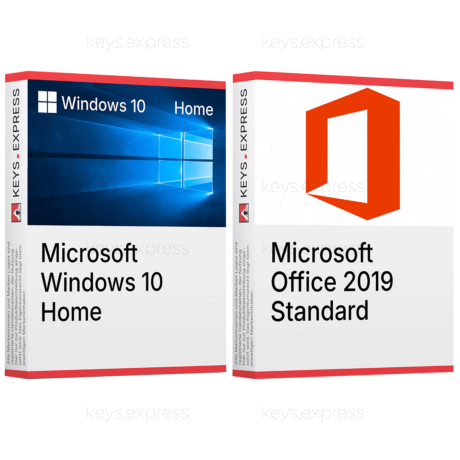

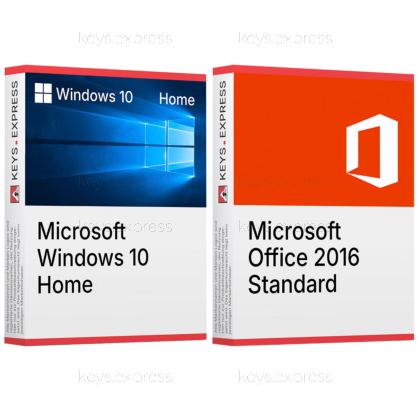
Operating system and desktop Office suite for a PC that is staying on Windows 10, matched so that Microsoft lists one as a supported platform for the other.
Microsoft Office 2016 Standard – Word, Excel, PowerPoint, Outlook, OneNote and Publisher as installed desktop applications. Publisher is what separates Standard from Office 2016 Home & Business; Access and Skype for Business belong to Professional Plus and are not part of this edition.
Microsoft Windows 10 Home – the consumer edition of Windows 10, with Microsoft Defender, Windows Search and Device Encryption on supported hardware. BitLocker management, Hyper-V, Remote Desktop hosting and Group Policy are reserved for Windows 10 Professional.
This product is not posted to the MS account and is not transferable to other devices.
This product allows a one-time activation for one device. Once used, it cannot be used again, not even for the same device.
In stock
Office applications – Word, Excel, PowerPoint, Outlook, OneNote and Publisher.
Publisher included – Page layout for flyers, newsletters and brochures.
Windows 10 Home – Consumer edition of the Windows 10 desktop system.
Device Encryption – Available on Home instead of BitLocker management.
Supported pairing – Microsoft lists Windows 10 for Office 2016.
Important – Access, Skype for Business and Teams are missing.
Microsoft names Windows 10 as a supported operating system for Office 2016, which makes this a documented pair rather than two products that merely coexist on the same disk. The dependency goes further than the compatibility list: Office 2016 requires the .NET Framework 3.5 that Windows supplies as an optional feature, and Outlook's Instant Search runs on the Windows Search service instead of an indexer the suite brings with it.
Supported pairing – Microsoft lists Windows 10 for Office 2016.
Edition unrestricted – Microsoft names Windows 10, not one edition.
Outlook search – Instant Search runs on Windows Search 4.0.
Framework dependency – Office 2016 needs .NET 3.5 from Windows.
Matched generation – Both left Microsoft support in October 2025.
Combined price – Lower than the two keys bought separately.
Yes. Microsoft's system requirements for Office 2016 Standard name Windows 11, Windows 10, Windows 10 LTSB 2016, Windows 10 LTSB 2015 and Windows Server 2016 as the supported operating systems, and the Windows 10 entry is not tied to a particular edition, so Home is enough to run the suite. Two Windows components matter beyond the list itself: Microsoft states that Office 2016 requires the .NET Framework 3.5, which Windows 10 provides as an optional Windows feature, and that Instant Search in Outlook requires Windows Search 4.0. Office 2016 is also listed as supported on Windows 11, so the operating-system half of this bundle earns its place on a machine that is staying on Windows 10 or being rebuilt with it, not on one that is about to move up.
Set up Windows 10 Home first, then install Office 2016 Standard into the finished system. A clean Windows setup erases the system volume, so an Office installation made beforehand is wiped together with its program files and registry entries and has to be repeated. Before starting the Office installation, switch on the .NET Framework 3.5 feature in Windows, because Microsoft lists .NET 3.5 as a requirement for Office 2016 and Windows 10 does not enable it by default. If Device Encryption is going to be used, turn it on before copying over document archives and Outlook data files, so those files are written to a volume that is already encrypted.
It fits a PC that is staying on Windows 10 and needs the operating system and a locally installed Office suite in one step. The case it covers better than either half alone is print work on an offline machine: Publisher 2016 is in Standard and in no smaller Office 2016 suite, while Windows 10 supplies the search index that Outlook's Instant Search depends on, so a workshop, practice or small office can lay out a newsletter and search years of correspondence without a Microsoft 365 service behind either task. If the PC is eligible for Windows 11 and nobody there opens a Publisher file, that argument does not apply and a current Office generation on a current operating system is the more sensible purchase.
Through Device Encryption, not through BitLocker Drive Encryption. Microsoft states that Device Encryption is available on a wider range of devices including those running Windows Home, while BitLocker Drive Encryption is available on the Pro, Enterprise and Education editions, so what Home offers is a simplified on-or-off setting tied to the PC meeting Microsoft's conditions, without the per-drive BitLocker management tools. This matters more with Office 2016 than with a subscription installation, because Microsoft confirms that Office as a one-time purchase includes none of the Microsoft 365 services: Word documents, Excel workbooks and Outlook data files stay on the local disk. If per-drive encryption or the BitLocker management tools are a requirement, the Windows edition is the component to change, not the Office half.
Whenever one half is already on the machine. A PC that is already running an activated Windows 10 needs only the Office key, and the reverse applies to a machine that already carries a working Office installation. Buy separately as well if the PC can move to Windows 11, since Microsoft lists Office 2016 as supported there too and the Office key alone can be paired with a newer operating system. And if the work never leaves Word, Excel, PowerPoint and Outlook, a smaller Office 2016 suite covers it, because Publisher is the application that separates Standard from the Home & Business edition.
Access, Skype for Business and Microsoft Teams. Access and Skype for Business belong to Office 2016 Professional Plus rather than Standard, and Teams was never part of the Office 2016 generation. Office 2016 also carries none of the Microsoft 365 services: Microsoft states that Office as a one-time purchase does not include Exchange Online or SharePoint Online, and that connections to Microsoft 365 services are no longer supported for this Office generation. On the Windows side, Windows 10 Home contains no BitLocker Drive Encryption, no Hyper-V, no Remote Desktop hosting, no Group Policy and no domain join, all of which Microsoft keeps for the Professional edition. Both products left Microsoft support on 14 October 2025; for the Windows half, Microsoft's consumer Extended Security Updates programme covers eligible Windows 10 version 22H2 devices until 12 October 2027, while Office 2016 has no equivalent route.
| Task | Office 2016 Standard | Windows 10 Home |
|---|---|---|
| Documents and spreadsheets | ✓ | ✕ |
| Outlook desktop client | ✓ | ✕ |
| Print layout and publications | ✓ | ✕ |
| Operating system | ✕ | ✓ |
| Windows Search index | ✕ | ✓ |
| Built-in virus protection | ✕ | ✓ |
| Drive encryption | ✕ | Device Encryption only |
| BitLocker management | ✕ | ✕ |
| Local databases | ✕ | ✕ |
| Microsoft 365 services | ✕ | ✕ |
No. Windows 10 Home includes no Word, Excel, PowerPoint, OneNote or Publisher, which is why the Office suite is the second half of this bundle. Any mail program that ships with Windows is a separate, simpler application and not the Outlook 2016 desktop client that comes with Office 2016 Standard.
Yes. Each key covers its own product, so Office 2016 Standard can be installed on any operating system Microsoft lists for it, and Windows 10 Home runs with no Office suite installed at all. They are sold together because Microsoft names Windows 10 as a supported platform for Office 2016, not because either product requires the other key.
Yes. Publisher 2016 is included alongside Word, Excel, PowerPoint, Outlook and OneNote, and it is the application that distinguishes Standard from the smaller Office 2016 suites. Publisher runs on Windows only and has never been part of the macOS versions of Office.
keys.express and keys.discount are online platforms for product keys. The product keys available in our shops for Windows and other software are inexpensive, secure, legal and come with an activation guarantee.
Below you will find the most important legal information about our products.
We offer exclusively unused and non-activated product keys. The keys have never been redeemed for activation and are fully available to the purchaser for the first-time activation of the respective product. A key that has already been redeemed could no longer be used for a new activation and is therefore not offered by us.
Trading in these product keys is permissible in the European Union and in Switzerland under current case law, provided that the necessary conditions are met. These conditions are as follows:
This trade is legally permissible because the underlying license was already placed on the market with the consent of the rightholder within the EU/EEA or Switzerland in return for appropriate remuneration. As a result, the so-called principle of exhaustion has taken effect, which permits the resale of individual product keys — in particular those originating from volume license agreements. Microsoft or the respective software provider has already received appropriate remuneration for this.
keys.express and keys.discount ensure that the aforementioned conditions are met and that the lawful use of the software is guaranteed. The requirements arising from European legislation are also observed in Switzerland.
Important note: The acquisition of a product key through the transmission of a combination of numbers and letters in digital form does not, in itself, constitute a license for the lawful use of the program. The license only arises from the respective installation and the associated acceptance of the manufacturer's terms of use.
Further information can be found here: