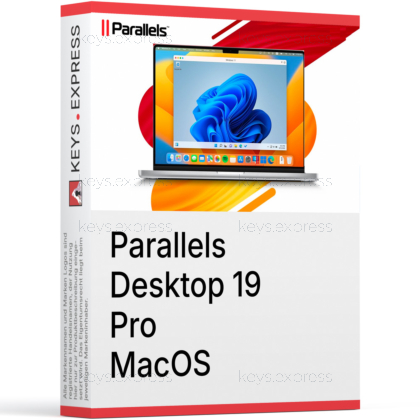
What are the main features and advantages of Parallels Desktop 19 Pro MacOS?
Developer Tools – Supports advanced virtual machines for testing workflows.
Seamless Integration – Runs Windows and Mac apps side by side.
Resource Control – Gives finer tuning for demanding virtual environments.
Apple Optimization – Delivers smooth performance on modern Mac hardware.
Fast Switching – Moves between systems without restarting your Mac.
Workflow Excellence – Supports long-term productivity across complex cross-platform tasks.
Download: Parallels Desktop 19 Pro MacOS
Multi-OS Virtualization – Windows 11, Linux, and macOS guests without rebooting.
Pro Performance – Up to 128 GB vRAM and 32 vCPUs.
Developer Tools – CLI tools, Visual Studio plug-in, and Vagrant support.
Advanced Networking – Network conditioner for connection testing and debugging.
Mac Integration – Run Windows apps beside Mac apps via Coherence.
Important – On Apple silicon Macs, only Arm-based Windows runs.
Parallels Desktop 19 Pro runs Windows, Linux, and other operating systems alongside macOS on the same Mac, with no reboot. The Pro edition targets developers, testers, and power users who need higher per-VM resources and automation that the Standard edition does not provide.
No Reboot – Switch between macOS and Windows instantly.
Resource Scaling – Assign heavy CPU and memory to VMs.
Automation Ready – Control and script VMs from the terminal.
Cross-Browser Testing – Test sites across Windows and Linux browsers.
Snapshots – Roll VMs back to earlier saved states.
Free Toolbox – Bundled Parallels Toolbox utilities at no charge.
It runs Windows 11, Linux, and macOS virtual machines directly on a Mac without rebooting or partitioning the drive. On Intel Macs it can assign up to 128 GB vRAM and 32 vCPUs to a single VM; on Apple silicon Macs the ceiling is 62 GB vRAM and 18 vCPUs per VM. Coherence mode lets Windows applications run side by side with Mac apps while the Windows desktop stays hidden. This makes it practical to keep one Windows tool, such as a Windows-only accounting or CAD package, open all day next to native Mac software.
It fits developers, QA testers, and power users who outgrow the Standard edition's 8 GB vRAM and 4 vCPU per-VM limit. The Pro edition adds command-line control through prlctl and prlsrvctl, a Visual Studio plug-in, and a network conditioner that simulates slow or unstable connections for realistic app testing. A web developer can keep several browser VMs running at once to check a site across Windows and Linux without a second machine. The extra per-VM headroom also matters for memory-hungry work such as running a Windows database or compiling large projects inside a VM.
Pro sits between Standard and Business. Standard caps each virtual machine at 8 GB vRAM and 4 vCPUs and is aimed at occasional Windows use; Pro raises that to 128 GB vRAM and 32 vCPUs and adds developer and automation tools. Business includes everything in Pro and layers on centralized license management and mass deployment for IT teams, but offers no extra per-VM power over Pro. If you work alone and need performance plus scripting, Pro is the relevant tier; the management features of Business only pay off when administering many Macs.
| Feature | Standard | Pro | Business |
|---|---|---|---|
| Max vRAM per VM | 8 GB | 128 GB | 128 GB |
| Max vCPUs per VM | 4 | 32 | 32 |
| Command-line tools | ✕ | ✓ | ✓ |
| Visual Studio plug-in | ✕ | ✓ | ✓ |
| Network conditioner | ✕ | ✓ | ✓ |
| Centralized management | ✕ | ✕ | ✓ |
No. On Apple silicon (M-series) Macs, only Arm-based operating systems run, so you install the Arm version of Windows 11 and Arm builds of Linux, not the classic x86/x64 Windows. Microsoft has authorized this Arm Windows 11 setup as the official way to run Windows on M-series Macs. Nested virtualization in the Pro edition is also Intel-only and is not available on Apple silicon. Before buying, confirm that any Windows-only software you depend on has an Arm-compatible path, since some legacy 32-bit or x86-specific applications may not run as expected.
The Pro edition adds command-line tools, prlctl and prlsrvctl, that let you create, configure, and control virtual machines from scripts, plus integration with tools such as Vagrant. It also includes a Visual Studio plug-in to build in one VM and test in others with a single action, and a VM upload feature that converts a VM bundle into one file for easier sharing or deployment. These tools are aimed at CI/CD workflows where machines are created and discarded automatically rather than managed by hand. Pro also bundles a no-charge Parallels Toolbox subscription, a separate set of single-purpose Mac utilities.
No, a Windows license is not included. Parallels Desktop can download and install Windows 11 for you, but you supply your own Windows license; on Apple silicon Macs this must be an Arm build of Windows 11. Linux distributions such as Ubuntu and Fedora remain free to install.
Yes. Version 19 was released with compatibility for macOS Sonoma 14 as a host, including a reworked shared printing path that uses the Internet Printing Protocol for Windows apps. Later 19.x updates continued to refine Sonoma stability on both Intel and Apple silicon Macs.
It can, but only for macOS versions that the host Mac itself supports as an operating system, and support is limited rather than guaranteed. This is useful for isolated testing or keeping a clean macOS environment, though Apple silicon imposes tighter constraints on macOS guests than Intel Macs do.
| Operating Systems | macOS 14.0 Sonoma or newer macOS 13.4 Ventura or newer macOS 12.6 Monterey or newer macOS 11.7 Big Sur or newer macOS 10.15.7 Catalina or newer macOS 10.14.6 Mojave or newer |
| Processor | Apple M3, M3 Pro, M3 Max, M2, M2 Pro, M2 Max, M2 Ultra, M1, M1 Pro, M1 Max and M1 Ultra chips. Intel Core i5, Core i7, Core i9, Intel Core M or Xeon processor. |
| Memory RAM | 4 GB of RAM minimum. 16 GB of RAM or more recommended for best performance. |
| Hard Disk | 600 MB for Parallels Desktop application installation. Additional disk space required for the guest operating system. At least 16 GB required for Windows 11 installation. |
| Note | Internet connection is required for product activation, updates, and select features. macOS 11.7 Big Sur or newer, macOS 10.15.7 Catalina or newer, and macOS 10.14.6 Mojave or newer are not supported by Parallels Desktop 19 directly; the product installer will set up an earlier product version and guest operating system support can be limited. Only Arm versions of operating systems are supported on Mac with Apple M series chips. Only x86 versions of operating systems are supported on Mac with Intel processor. Windows 10 guest operating system support on Mac with Intel processor is limited to 64-bit version. To run legacy Windows OS versions 2000, XP, Vista, 7, 8, and 8.1, download and use Parallels Tools version 18.3.0. Parallels Tools are not available for Gentoo Linux, Solaris 11 and 10, OpenBSD 6, FreeBSD 12 and 11, eComStation 2 and 1.2, and ReactOS 0.4 guest operating systems. Virtual machines with Mac OS X Leopard Server 10.5.x through OS X Mountain Lion 10.8.x are not supported in Parallels Desktop 19.3.0 and newer versions. |