
↑
Back to Top
What are the core functionalities and main benefits of Acronis Cyber Protect Advanced?
Automated Backup – Protects systems and data with scheduled recovery points.
Active Defense – Blocks ransomware and malicious changes in real time.
Granular Recovery – Restores files, systems, and workloads with precision.
Unified Management – Combines backup and protection in one console.
Patch Automation – Reduces risk by closing security gaps faster.
Digital Reliability – Supports stable protection, recovery, and long-term operational continuity.

Integrated protection – Backup and full-stack anti-malware in one agent.
Backup malware scan – Checks backup archives for malware before restore.
Safe recovery – Restores systems without reintroducing detected threats.
Bare-metal restore – Rebuilds whole systems onto dissimilar hardware.
Backup notarization – Verifies file integrity using blockchain-based Acronis Notary.
Core Capacity – Licensed per workstation, server, and virtual host.
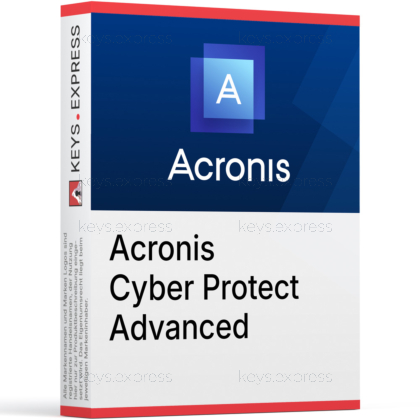
Acronis Cyber Protect Advanced is the enterprise edition that combines image-based backup, disaster recovery, and full-stack anti-malware in a single agent and console. It targets larger or multi-site environments that need both data protection and integrated security without running separate tools.
One console – Manage backup and security from one place.
Lower restore risk – Recover clean systems after a ransomware attack.
Faster recovery – One-click bare-metal restore reduces downtime.
Broad coverage – Protects physical, virtual, and cloud machines.
Patch then backup – Fail-safe patching backs up before applying updates.
Vendor consolidation – Replaces separate backup and antivirus products.
Acronis Cyber Protect Advanced merges image-based backup, disaster recovery, and full-stack anti-malware into a single agent and management console. Instead of running separate backup and security products, one protection plan handles scheduled backups, anti-ransomware, and URL filtering together. A defining capability is that it scans backup archives for malware before a restore, so an infected snapshot is not brought back into a clean environment. During recovery it can also update antivirus definitions and apply patches, which lowers the chance of immediate reinfection.
It fits IT teams running larger or multi-site environments that mix physical servers, virtual machines, and cloud workloads under one protection policy. The practical reason to choose Advanced over a basic backup tool is shared protection plans and a centralized dashboard, which let one administrator apply the same backup and security rules across many machines instead of configuring each one separately. Licensing is applied per protected workload by type — workstation, server, or virtual host — so the environment scales by adding workloads rather than buying a fixed bundle. This suits organizations that want both data protection and integrated security without managing two vendors.
Advanced is the top tier and the only one of the three that pairs advanced backup with advanced cybersecurity in the same edition. Standard provides standard backup plus baseline security such as continuous data protection, URL filtering, and disk health monitoring, but not the advanced backup storage options. Backup Advanced adds tape support, deduplication, and off-host data processing, yet limits security to essential ransomware and cryptojacking protection. Advanced is the edition that adds backup malware scanning, safe recovery, security posture assessment, and Endpoint Detection and Response. The table below summarizes the main differences.
| Feature | Standard | Advanced | Backup Advanced |
|---|---|---|---|
| Standard backup & recovery | ✓ | ✓ | ✓ |
| Advanced backup (tape, deduplication) | ✗ | ✓ | ✓ |
| Anti-ransomware (Active Protection) | ✓ | ✓ | ✓ |
| Scan backups for malware | ✗ | ✓ | ✗ |
| Safe recovery | ✗ | ✓ | ✗ |
| Security posture assessment | ✗ | ✓ | ✗ |
| Endpoint Detection & Response | ✗ | Cloud only | ✗ |
No — Endpoint Detection and Response in Acronis Cyber Protect 16 is available with cloud deployment only, not when the management server runs entirely on-premises. If your machines are isolated from the internet and all components must stay in your own network, you still get backup malware scanning, safe recovery, and anti-ransomware, but not the EDR investigation layer. A second deployment constraint is that the management server cannot be installed on macOS, so a Mac-only environment has to use cloud deployment. Anyone planning a fully on-premises rollout should confirm which security features their deployment model actually exposes before buying.
It protects Windows, Linux, and macOS systems across physical, virtual, and cloud workloads, with bare-metal recovery and Universal Restore to dissimilar hardware. For virtualization, an Advanced license is specifically required to back up virtual machines on Citrix XenServer, KVM, Red Hat Virtualization, and Oracle VM Server, while VMware vSphere and Microsoft Hyper-V are covered by the Standard license. On the storage side it supports local disks, network shares, tape, and SAN snapshots, with deduplication to reduce backup size. This split matters for mixed-hypervisor estates where one tool has to cover both mainstream and less common virtualization platforms.
Yes. Universal Restore recovers a bare-metal backup onto hardware that differs from the original machine by injecting the required drivers during recovery, and it supports physical-to-virtual and virtual-to-physical migrations. This helps when replacing a failed server with a different model or moving a workload between physical and virtual environments.
On protected workloads it can. The edition includes full-stack anti-malware with behavior-based Active Protection, exploit prevention, and URL filtering, so the same agent that runs backups also blocks malware and ransomware. This lets teams consolidate backup and endpoint security onto one agent instead of running an independent antivirus alongside it.
Yes. It includes vulnerability assessment and patch management, and its fail-safe patching automatically backs up an endpoint before applying an update so you can roll back if a patch causes problems. This ties software updates directly to recovery points, reducing the risk of a bad patch taking a machine offline.
| Operating Systems |
Windows 11: Home / Pro / Education / Enterprise |
| Processor | Not Specified |
| Memory RAM | 150 MB minimum memory consumption for Agent for Windows |
| Hard Disk | 850 MB disk space required for installation for Agent for Windows |
| Display | Standard display compatible with the respective operating system |
| Special Features | File level and image based backup Local backup and NAS or share backup Incremental and differential backup Multi destination backup and archive compression Bare metal recovery and Universal Restore Ransomware and cryptojacking protection Antivirus and anti malware protection Exploit prevention URL filtering URL filtering with categorization Windows Defender Antivirus management on Windows 8.1 and later Microsoft Security Essentials management Threat Feed Remote device wipe HDD health monitoring Continuous data protection Malware scanning of backups Safe recovery of backups Corporate allowlist Vulnerability assessments for Windows Vulnerability assessments for third party Windows applications Patch Management Fail safe patching Remote Desktop |
| Note | Windows 7 systems require Servicing Stack Update KB4490628 and SHA 2 Code Signing Support Update KB4474419. Windows Defender Antivirus management is supported on Windows 8.1 and later. Administrative rights are required for agent installation and management. |
| Operating Systems | macOS Tahoe 26 macOS Sequoia 15 macOS Sonoma 14 macOS Ventura 13 macOS Monterey 12 macOS Big Sur 11 macOS Catalina 10.15 macOS Mojave 10.14 macOS High Sierra 10.13 macOS Sierra 10.12 |
| Processor | Not Specified |
| Memory RAM | 150 MB minimum memory consumption for Agent for Mac |
| Hard Disk | 500 MB disk space required for installation for Agent for Mac |
| Display | Standard display compatible with the respective operating system |
| Special Features | File level and image based backup for Mac workloads Local backup and NAS or share backup Incremental and differential backup Antivirus and anti malware protection Protection against ransomware that targets backups and backup processes Vulnerability assessments for macOS |
| Note | Management Server cannot be installed on a Mac. Cloud deployment is recommended for a Mac only environment or for a single Mac to back up. Administrative rights are required for agent installation and management. |
| Operating Systems | Android 7.0 or later |
| Processor | Not Specified |
| Memory RAM | Requirements met by any device running the supported OS version. |
| Hard Disk | 9.2 MB app package size |
| Display | Standard display compatible with the respective operating system |
| Special Features | Mobile backup of photos Mobile backup of videos Mobile backup of contacts Mobile backup of SMS messages Mobile backup of calendars Cloud backup over Wi Fi or cellular connection Recovery to the same device or a new device Device to device data transfer Centralized backup management through the Cyber Protection Console |
| Note | The mobile app is designed for use with the business focused Acronis Cyber Protect Cloud service. Internet access is required for cloud backup and recovery. |
| Operating Systems | iOS 12.0 or later |
| Processor | Not Specified |
| Memory RAM | Requirements met by any device running the supported OS version. |
| Hard Disk | 18.4 MB app size |
| Display | Standard display compatible with the respective operating system |
| Special Features | Mobile backup of contacts Mobile backup of photos Mobile backup of videos Mobile backup of reminders Mobile backup of calendars Cloud backup over Wi Fi or cellular connection Recovery to the same device an alternate device or a new device Device to device data transfer Centralized backup management through the Cyber Protection Console |
| Note | The mobile app is designed for use with the business focused Acronis Cyber Cloud service and requires an account there. Internet access is required for cloud backup and recovery. |