

What are the main features and advantages of Parallels Desktop 20 Pro MacOS?
Developer Tools – Supports advanced virtual machines for testing workflows.
Seamless Integration – Runs Windows and Mac apps side by side.
Resource Control – Gives finer tuning for demanding virtual environments.
Apple Optimization – Delivers smooth performance on modern Mac hardware.
Fast Switching – Moves between systems without restarting your Mac.
Workflow Excellence – Supports long-term productivity across complex cross-platform tasks.
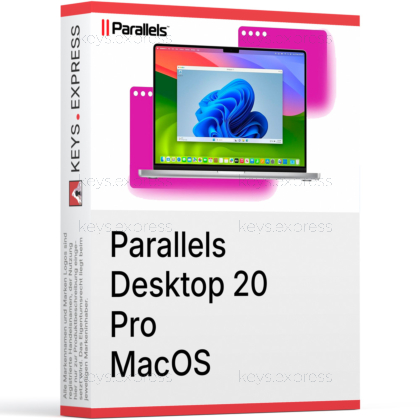
Download: Parallels Desktop 20 Pro MacOS
Virtual machines – Run Windows, Linux, macOS on Mac.
Pro performance – More vCPUs and vRAM than Standard edition.
Developer tools – Command-line interface, Visual Studio plug-in, automation.
Parallels Toolbox – Included set of essential Mac utilities.
Performance Metric – Up to 32 vCPUs and 128GB per VM.
Important – Windows is not included; bring your own license.
Parallels Desktop 20 Pro is virtualization software that runs Windows, Linux, and other operating systems alongside macOS on the same Mac. The Pro edition targets developers and power users who need higher virtual machine resources and automation tools.
No reboot – Switch between macOS and Windows instantly.
Higher limits – Up to 32 vCPUs, 128GB per VM.
Developer ready – CLI, Visual Studio plug-in, nested virtualization.
Cross-platform testing – Run Windows, Linux, macOS guests together.
Mac-native feel – Shared files, clipboard, and peripherals across systems.
Free Toolbox – Includes the Parallels Toolbox utility set.
Parallels Desktop 20 Pro runs Windows, Linux, and macOS as virtual machines directly on a Mac without rebooting. The Pro edition raises the per-VM ceiling to 32 vCPUs and 128GB of vRAM on Intel Macs, and up to 18 vCPUs and roughly 62GB on Apple silicon, against 4 vCPUs and 8GB in the Standard edition. That headroom matters when you compile large projects, run a local database server, or keep several test environments open at once. You can drag files between macOS and the guest, share folders, and use Mac cameras, printers, and audio inside Windows. It is built for ongoing cross-platform work rather than occasional use of a single Windows app.
Parallels Desktop 20 Pro is built for developers, QA testers, and IT professionals who need more than a single lightweight Windows VM. The concrete reason to pick Pro over Standard is the command-line interface, the Visual Studio plug-in, nested virtualization, and integrations such as Vagrant, none of which exist in Standard. A web developer can run several browser-test VMs in parallel, while a backend engineer can run nested hypervisors for container work. If you only need to launch one Windows program now and then, Standard covers that for less. Pro earns its place when virtualization is part of your daily routine.
The differences come down to resource limits, developer tooling, and central management. Standard caps each virtual machine at 4 vCPUs and 8GB of vRAM, while Pro and Business raise that to 32 vCPUs and 128GB on Intel Macs. Pro adds the command-line interface, the Visual Studio plug-in, nested virtualization, and a no-charge Parallels Toolbox subscription. Business keeps the full Pro feature set and adds centralized license management, the Management Portal, and single sign-on for IT teams. The table below shows where each edition differs.
| Feature | Standard | Pro | Business |
|---|---|---|---|
| vCPUs per VM | 4 | 32 | 32 |
| vRAM per VM | 8GB | 128GB | 128GB |
| Command-line interface | ✕ | ✓ | ✓ |
| Visual Studio plug-in | ✕ | ✓ | ✓ |
| Nested virtualization | ✕ | ✓ | ✓ |
| Parallels Toolbox | ✕ | ✓ | ✓ |
| Centralized management | ✕ | ✕ | ✓ |
No. Parallels Desktop 20 Pro is the virtualization layer only and does not include a Windows, Linux, or macOS license. You supply your own Windows key, and Microsoft officially supports the Arm build of Windows 11 Pro and Enterprise running through Parallels on Apple silicon Macs. The app can download and set up Windows 11 for you, but activation still needs a valid license you own or buy separately. If you do not already have a Windows key, budget for one on top of the Parallels subscription.
Yes, with one important constraint: Apple silicon Macs natively run only the Arm versions of Windows, Linux, and macOS guests. From version 20.2, the Pro, Business, and Enterprise editions can also run the Intel (x86) build of Windows on Apple silicon, but it runs through emulation and is slow enough to suit occasional developer testing rather than daily use. Most Windows applications now ship an Arm build or run through Windows' own x64 translation layer. Intel-based Macs can still run Windows 10 the traditional way, though older Windows releases are no longer supported. Check that the specific software you rely on has an Arm-compatible version before committing.
Confirm three things first: whether you actually need Pro's developer features, which Windows build your apps require, and whether you already own a Windows license. Pro only makes sense over Standard if you use the command-line interface, nested virtualization, multiple simultaneous VMs, or RAM and CPU allocation above 8GB and 4 vCPUs. If you manage VMs across a team and need centralized licensing or the Management Portal, that is the Business edition, not Pro. Also check your Mac's physical RAM, since a virtual machine cannot use more memory than the host can spare. These checks stop you buying a tier that is either too limited or more than you need.
Yes. A Pro subscription includes a no-charge subscription to Parallels Toolbox, a separate set of one-click Mac utilities for tasks such as screen capture, archiving, and freeing disk space. It is bundled with Pro and is not part of the Standard edition.
Pro is tuned for resource-intensive work and can run graphically demanding apps and CAD tools such as Autodesk software inside a VM, helped by its higher vRAM and vCPU ceilings. Performance still depends on your Mac's hardware, since Parallels shares the host GPU rather than passing through a dedicated graphics card. For sustained 3D or rendering loads, allocate more memory and test with your real project files before relying on it.
| Operating Systems | macOS 15.0 Sequoia or newer macOS 14.0 Sonoma or newer macOS 13.4 Ventura or newer macOS 12.6 Monterey or newer macOS 11.7 Big Sur or newer macOS 10.15.7 Catalina or newer macOS 10.14.6 Mojave or newer |
| Processor | Apple M4, M4 Pro, M4 Max, M3, M3 Pro, M3 Max, M2, M2 Pro, M2 Max, M2 Ultra, M1, M1 Pro, M1 Max, and M1 Ultra chips. Intel Core i5, Core i7, Core i9, Intel Core M, or Xeon processor. |
| Memory RAM | 4 GB RAM minimum. 16 GB RAM or more for best performance. |
| Hard Disk | 600 MB free space for Parallels Desktop application installation. Additional disk space required for guest operating systems. At least 16 GB required for a Windows virtual machine. |
| Note | Internet connection is required for product activation, updates, and select features. macOS 11.7 Big Sur or newer, macOS 10.15.7 Catalina or newer, and macOS 10.14.6 Mojave or newer are not supported by Parallels Desktop 20 directly; the product installer will set up an earlier product version and guest operating system support can be limited. Only Arm versions of operating systems are supported on Mac with Apple M series chips. Only x86 versions of operating systems are supported on Mac with Intel processor. Windows 10 guest operating system support on Mac with Intel processor is limited to 64-bit version. Legacy Windows 2000, Windows XP, Windows Vista, Windows 7, Windows 8, Windows 8.1, and Windows Server 2012 R2 guest operating system support is limited. Parallels Tools are not available for Gentoo Linux, OpenBSD 6, FreeBSD 12 and 11, eComStation 2 and 1.2, and ReactOS 0.4 guest operating systems. |