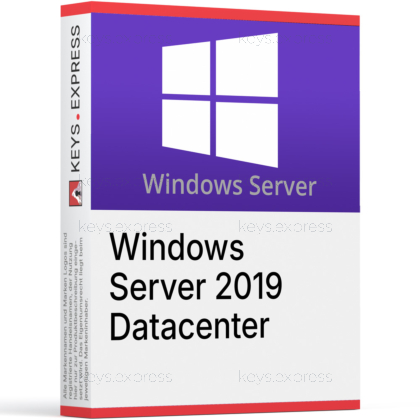
What are the main features and advantages of Microsoft Server 2019 Datacenter?
Unlimited Virtualization – Run unlimited Windows VMs on licensed hosts.
Shielded Security – Protect VMs from tampering and credential theft.
Storage Spaces – Build fast resilient storage using local drives.
SDN Networking – Segment networks and automate datacenter connectivity.
Container Support – Run Windows containers for modern app delivery.
Hybrid Integration – Connect servers to cloud tools for management.
Download: Server 2019 Datacenter
Unlimited Virtualization – Run unlimited Windows VMs per licensed host
Storage Spaces Direct – Pool local disks into clustered software-defined storage
Shielded VMs – Encrypt and lock guest VMs against compromised hosts
Software-Defined Networking – Manage network policy without dedicated hardware appliances
Storage Replica – Unlimited volume replication for disaster recovery failover
Core Capacity – Per-core model, 16-core minimum, CALs sold separately
Windows Server 2019 Datacenter is Microsoft's top 2019 server edition, built for heavily virtualized data centers and private-cloud hosts. It bundles every Datacenter-only feature: unlimited VMs, Storage Spaces Direct, Shielded VMs, and Software-Defined Networking.
VM Density – License cores once, run unlimited guests
Hyper-Converged Storage – Build resilient clusters without a separate SAN
Workload Isolation – Shielded VMs protect tenant data from admins
Hybrid Ready – Connects on-premises hosts to Azure services
Inherited Activation – Activate Standard guests automatically on this host
Long Support – Extended Microsoft support runs through January 2029
It runs server workloads and an unlimited number of Hyper-V virtual machines on one licensed physical host, which is the core reason to choose Datacenter over Standard. On Standard you may run only two VMs per fully licensed server, then must re-license all cores for each additional pair, so dense virtualization quickly becomes cheaper on Datacenter. The edition also adds Storage Spaces Direct and Storage Replica, letting you build clustered storage from local disks instead of buying a SAN. For a host packing many VMs onto a few physical servers, this combination removes both the per-VM licensing math and the external storage cost.
The two editions share the same code base and roles, but Datacenter removes the virtualization cap and unlocks the software-defined features Standard locks out. Standard is limited to two operating system environments per fully licensed server and cannot run Storage Spaces Direct, Shielded VMs, or full Software-Defined Networking. Standard's Storage Replica is also capped at one partnership and a single 2 TB volume, while Datacenter allows unlimited replicas. Choose Datacenter when VM count is high or you need clustered local storage; choose Standard for a few fixed VMs where those features are unnecessary.
| Feature | Standard 2019 | Datacenter 2019 |
|---|---|---|
| Virtual machines | 2 per license | Unlimited |
| Storage Spaces Direct | ✕ | ✓ |
| Shielded VMs | ✕ | ✓ |
| Software-Defined Networking | ✕ | ✓ |
| Storage Replica | 1 × 2 TB | Unlimited |
| Core licensing minimum | 16 cores | 16 cores |
No. The Datacenter license covers the server operating system and its cores, but each user or device that accesses the server still needs a separate Windows Server CAL. A User CAL lets one named person connect from any number of devices, while a Device CAL lets any number of users share one device, so shift-based workers usually cost less with Device CALs. Remote Desktop sessions need a second, separate RDS CAL on top of the Windows Server CAL. Plan the CAL count before deployment, because the server runs but blocks unlicensed client access once configured for it.
Yes, the RDS role is built in, but it needs RDS CALs and an RD Licensing server to keep working past the 120-day grace period. RDS CALs are not edition-specific, so the same CAL works on Standard or Datacenter; what matters is version, since a 2019 session host requires a 2019-or-newer RDS CAL and will reject older 2016 CALs. After the grace window expires without valid CALs installed, remote sign-ins fail. Buy the RDS CALs separately and match or exceed the server version to avoid that lockout.
The main constraint is licensing math rather than features: you must license every physical core, with a minimum of 8 cores per processor and 16 cores per server, even on smaller hardware. Datacenter only pays off over Standard once you run many VMs or need Storage Spaces Direct, Shielded VMs, or full SDN, since those are the features Standard lacks. Mainstream support for Windows Server 2019 has ended, and extended support runs until January 2029, so it suits workloads not yet ready for Server 2022 or 2025. Confirm your core count and CAL needs first, because both add cost on top of the base license.
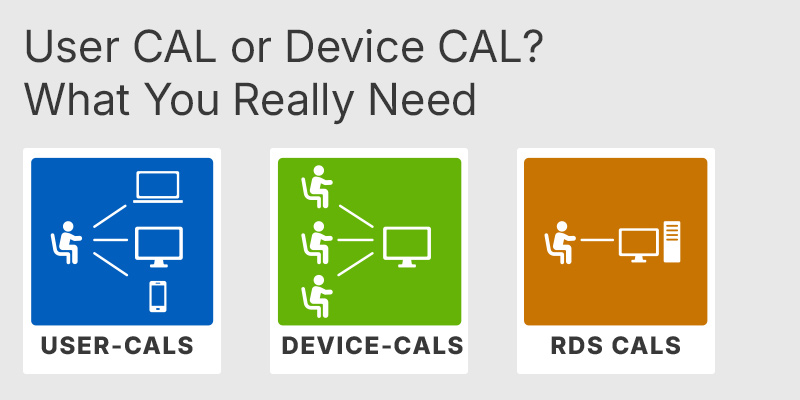
A User CAL is tied to a person and lets that one user reach the server from any number of devices, while a Device CAL is tied to hardware and lets any number of users connect from that single device. User CALs fit staff who use a laptop, phone, and desktop, since one CAL covers all three. Device CALs fit shared machines such as a shift-worked terminal or a shop-floor PC used by many people. Count whichever number is lower for your environment, because mixing both types is allowed and usually cheaper.
Yes. Once every physical core on the host is licensed, Datacenter grants rights to run an unlimited number of Windows operating system environments on that server. This is the single biggest difference from Standard, which caps you at two VMs before you must re-license all cores again.
Yes. Windows Server 2019 supports Automatic Virtual Machine Activation, so Standard or Datacenter guests inherit activation from a licensed Datacenter host without separate keys per VM. This simplifies activation across large VM fleets running on the same physical server.
No. RDS CALs are backward-compatible but not forward-compatible, so a 2016 RDS CAL cannot license a 2019 session host. You need a 2019-or-newer RDS CAL, and your RD Licensing server must run a version equal to or newer than the CAL.
| Processor | 1.4 GHz 64-bit processor. Compatible with x64 instruction set. Supports NX and DEP. Supports CMPXCHG16b, LAHF SAHF, PrefetchW. Supports Second Level Address Translation EPT or NPT. |
| Memory RAM | 512 MB for Server Core. 2 GB for Server with Desktop Experience. ECC Error Correcting Code type or similar technology recommended for physical host deployments. |
| Hard Disk | 32 GB minimum disk space for the system partition. |
| Display | Monitor capable of Super VGA 1024 x 768 or higher resolution. |
| Graphics | Graphics device capable of Super VGA 1024 x 768 or higher resolution. |
| Note | Minimum hardware requirements apply to Windows Server 2019 Standard and Datacenter editions unless otherwise specified. |
keys.express and keys.discount are online platforms for product keys. The product keys available in our shops for Windows and other software are inexpensive, secure, legal and come with an activation guarantee.
Below you will find the most important legal information about our products.
We offer exclusively unused and non-activated product keys. The keys have never been redeemed for activation and are fully available to the purchaser for the first-time activation of the respective product. A key that has already been redeemed could no longer be used for a new activation and is therefore not offered by us.
Trading in these product keys is permissible in the European Union and in Switzerland under current case law, provided that the necessary conditions are met. These conditions are as follows:
This trade is legally permissible because the underlying license was already placed on the market with the consent of the rightholder within the EU/EEA or Switzerland in return for appropriate remuneration. As a result, the so-called principle of exhaustion has taken effect, which permits the resale of individual product keys — in particular those originating from volume license agreements. Microsoft or the respective software provider has already received appropriate remuneration for this.
keys.express and keys.discount ensure that the aforementioned conditions are met and that the lawful use of the software is guaranteed. The requirements arising from European legislation are also observed in Switzerland.
Important note: The acquisition of a product key through the transmission of a combination of numbers and letters in digital form does not, in itself, constitute a license for the lawful use of the program. The license only arises from the respective installation and the associated acceptance of the manufacturer's terms of use.
Further information can be found here: