
↑
Back to Top
What are the key benefits and advantages of Microsoft Server 2019 Standard?
Flexible Hosting – Run core workloads on-premises or in VMs.
Built Security – Hardens identity, networking, and server access.
Modern Management – Simplifies administration with Windows Admin Center.
Hybrid Ready – Integrates smoothly with cloud services and tools.
Role Support – Includes essential roles for business infrastructure.
Virtual Rights – Allows two virtual machines per licensed server.
Download: Server 2019 Standard
Server roles – Active Directory, DNS, DHCP, file and print services.
Hyper-V – Run two licensed virtual machines on the host.
Storage Replica – One partnership, one volume up to 2 TB.
RDS roles – Built in, two admin sessions without extra CALs.
Core licensing – Minimum 16 cores per server, eight per processor.
Important – Unlimited Virtual Machines, Storage Spaces Direct, and Client Access Licenses (CALs) are not included in this edition.
Windows Server 2019 Standard is the per-core server operating system for physical or lightly virtualized workloads such as a domain controller, file server, or line-of-business application host. It carries the full server role set but caps virtualization at two VMs per fully licensed host, which is why it suits offices rather than dense virtualization farms.
Two VMs – Two virtual machines per fully core-licensed host.
Full roles – Same role catalog as the Datacenter edition.
Stackable cores – Relicense all cores to add two more VMs.
CAL model – Pairs with reusable User or Device CALs.
App host – Proven base for SQL, ERP, and file workloads.
RDS capable – Hosts remote sessions once RDS CALs are added.
Windows Server 2019 Standard is the operating system that runs core network infrastructure: Active Directory domain authentication, DNS, DHCP, file and print sharing, and application hosting. It is licensed per physical core, with a mandatory minimum of 16 core licenses per server and eight per processor, sold in two-core packs. The Standard edition includes rights to run two virtual machines or two Hyper-V containers once every physical core is licensed. In practice you deploy it where a single box handles directory services and a couple of server workloads, not where you need a large virtualization cluster. For heavier consolidation you double the core licensing to gain each additional pair of VMs, which is the point where Datacenter usually becomes cheaper.
The functional gap is virtualization density and software-defined infrastructure, not the everyday role set. Standard grants two VMs per fully licensed host and omits Storage Spaces Direct, Shielded VMs, and Software-Defined Networking, while Datacenter allows unlimited VMs and includes all three. Both editions share the same 16-core minimum and the same Server + CAL requirement, so directory, file, and print services behave identically. The decision is purely workload-driven: once a host needs roughly a dozen or more VMs, restacking Standard core licenses costs more than a single Datacenter license. Storage Replica also differs, Standard is limited to one partnership and a single volume up to 2 TB.
| Feature | 2019 Standard | 2019 Datacenter |
|---|---|---|
| Virtual machines | 2 per host | Unlimited |
| Storage Spaces Direct | ✕ | ✓ |
| Shielded VMs | ✕ | ✓ |
| Software-Defined Networking | ✕ | ✓ |
| Storage Replica | Limited | ✓ |
| CALs required | ✓ | ✓ |
| 16-core minimum | ✓ | ✓ |
One Windows Server 2019 Standard license covers two virtual machines, but only when every physical core on the host is licensed. To run a third and fourth VM you must license all the host cores a second time, doubling the core count rather than adding a small top-up. This stacking rule is what makes Standard economical for two to four VMs and expensive beyond that. A host with 16 cores running four VMs therefore needs 32 core licenses. If your roadmap involves many VMs on one host, calculate the stacked Standard cost against a single Datacenter license before buying.
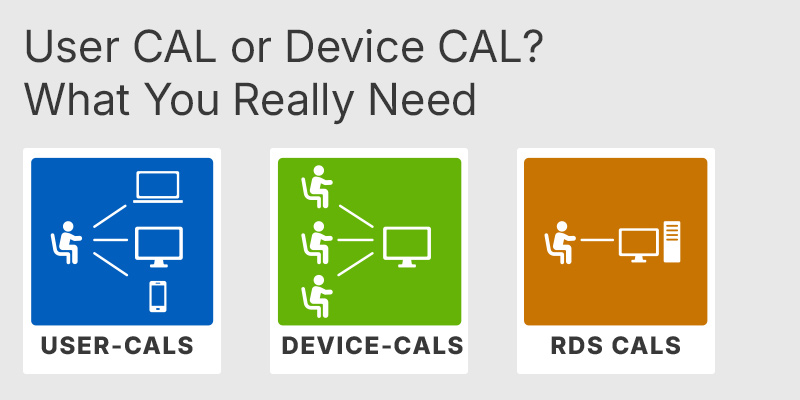
Yes. Windows Server 2019 Standard uses the Server + CAL model, so the core licenses cover the operating system while every user or device that accesses it needs a separate Windows Server CAL that is not included in the box. A User CAL follows one person across all their devices; a Device CAL covers one shared machine used by many people, such as a shift workstation. CALs are version-aligned and can be reused if you keep the same or older server version. Plan the CAL type around your access pattern: more people than devices favors Device CALs, more devices than people favors User CALs.
It allows two simultaneous administrative Remote Desktop connections out of the box for server management, with no RDS CAL needed. To let ordinary users run desktops or applications remotely you must enable the Remote Desktop Session Host role and buy separate RDS CALs, which are distinct from standard Windows Server CALs. Installing the RDS role starts a 120-day grace period before purchased RDS CALs must be in place. A full RemoteApp or RD Web deployment additionally needs the RD Connection Broker role. Budget both a Windows Server CAL and an RDS CAL per remote user, since the two licenses cover different rights.
Count the physical cores first: licensing starts at 16 cores per server even if the hardware has fewer, and every populated processor needs at least eight. Then confirm the VM plan, because more than two VMs forces you to relicense all cores per additional pair. Verify that you are not relying on Storage Spaces Direct, Shielded VMs, or Software-Defined Networking, as none of these exist in Standard. Finally, account for CALs separately, including RDS CALs if remote desktops are involved. Getting the core count and VM math right before purchase avoids the most common compliance gap on this edition.
| Processor | 1.4 GHz 64-bit processor. Compatible with x64 instruction set. Supports NX and DEP. Supports CMPXCHG16b, LAHF/SAHF, and PrefetchW. Supports Second Level Address Translation EPT or NPT. |
| Memory RAM | 512 MB for Server Core. 2 GB for Server with Desktop Experience. ECC memory type or similar technology recommended for physical host deployments. |
| Hard Disk | 32 GB available disk space for the system partition. |
| Display | Super VGA 1024 x 768 or higher-resolution monitor. |
| Graphics | Graphics device compatible with Super VGA 1024 x 768 or higher-resolution. |
| Note | DVD drive is required only if installing from DVD media. UEFI secure boot and Trusted Platform Module are required only for certain features. Keyboard and mouse are required only for certain features. Internet access may be required, fees may apply. Includes .NET Framework 4.7.2 with Windows Server 2019. .NET Framework 4.8 can be installed separately if required. |
keys.express and keys.discount is a web platforms for new and used product keys. The product keys for Windows and other software available in the shop of keys.express and keys.discount are cheap, safe, legal and with activation guarantee.
Here you can find some general information about used software, an overview of the most important legal information as well as answers to frequently asked questions from our customers ("FAQ“)
Used software is available for sale in the European Union as well as in Switzerland according to current jurisdiction provided that the necessary conditions are met. The necessary conditions are as follows:
keys.express and keys.discount ensure that the above mentioned requirements are met and that a legal use of the software is guaranteed. The requirements of the European legislation are also met in Switzerland.
You can find further information on:
There is a lot of legal information about the topic of used software. We are more than happy to answer any questions you may have. You can contact us at any time via welcome(at)keys.express. In the meantime, you can also find a short overview of the most important legal information regarding used software here:
For distance contracts concluded by telephone, on the Internet or when ordering from a catalogue, EU law provides for the possibility for consumers to withdraw from the contract for a certain period of time ("right of withdrawal"). A consumer in this sense is any natural person who concludes a legal transaction for purposes that are predominantly neither commercial nor self-employed. In Switzerland we usually speak of consumers.
Consumers have the right to cancel the contract within fourteen calendar days without giving reasons. The revocation period begins on the day the contract is concluded.
In order to exercise your right of withdrawal from keys.express or keys.discount, you must inform us by means of a clear statement (e.g. a letter, fax or e-mail sent by post) of your decision to withdraw from this contract. For this purpose, you can contact us using the following information:
Keys Distribution Ltd
Suite 2, 215 Main Street
Gibraltar Heights, Gibraltar
Phone +423 7989130
Email: welcome@keys.discount
keys.express and keys.discount also provides a template revocation form. In order to comply with the revocation period, it is sufficient to send the notification of the exercise of the right of revocation to Keys Distribution Ltd before the end of the revocation period.
If you revoke this contract, we must reimburse you for all payments which we have received from you for the corresponding order, including delivery costs (with the exception of additional costs which result from the fact that you have chosen a different type of delivery than the cheapest standard delivery offered by us), immediately and at the latest within fourteen calendar days from the day on which we receive notification of your revocation of this contract. For this repayment we will usually use the same means of payment that you used for the original transaction, unless expressly agreed otherwise with you. In no case will you be charged for this refund.