What are the main features and advantages of Microsoft Server 2019 User CAL?
User Access – One user can use server services anywhere.
Multi Device – Same user connects from multiple devices easily.
Simple Compliance – Track people once across all server roles.
Core Services – Covers file print and directory resource access.
Flexible Scaling – Add staff without re-licensing shared workstations.
Cost Control – Best when users switch devices often.
User access right – Licenses one named user to reach the server.
Any device – That user connects from phone, laptop or PC.
All services – Covers file, print, DHCP and directory access.
Edition independent – Works with Standard and Datacenter 2019 servers.
Backward coverage – Also valid for 2016 and earlier servers.
Core Capacity – Standard User CALs do not grant Remote Desktop access.
A Windows Server 2019 User CAL is the access license that legally permits one named person to use a Windows Server 2019 deployment. It sits on top of the server's per-core license, which by itself does not grant any user the right to connect.
Per-person model – Follows the user, not a single machine.
Roaming friendly – Same user logs in from multiple devices.
Compliance ready – Keeps your access licensing audit-clean.
Mixed environments – One CAL reaches 2019 and older servers.
Edition flexible – Identical CAL fits Standard or Datacenter.
Scales in packs – Add users without re-licensing the server.
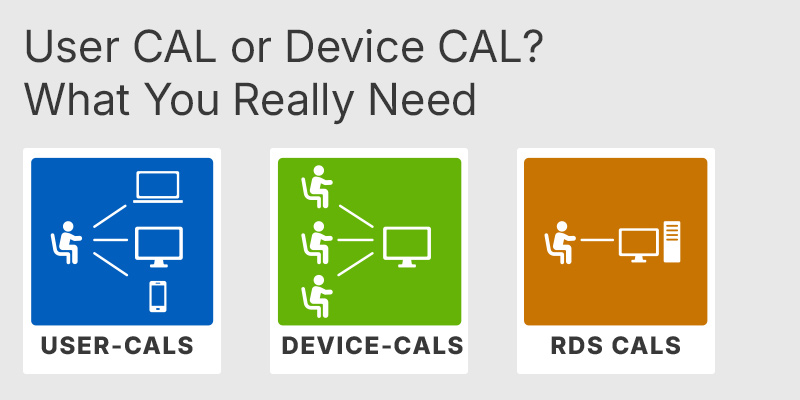
A User CAL gives one specific person the legal right to access a Windows Server 2019 instance, no matter how many devices they use to connect. The server's own license only permits you to install and run the operating system; every user reaching its services such as file shares, printing, DHCP or Active Directory authentication needs a CAL on top. Choose a User CAL when staff log in from several devices, for example a desktop, a laptop and a phone, because you license the person once instead of each machine. If instead many people share a small number of fixed workstations, a Device CAL is usually cheaper.
A User CAL licenses one named user across unlimited devices, while a Device CAL licenses one device for use by unlimited users. The cost decision comes down to your device-to-user ratio: if a worker uses three devices, one User CAL covers all three, whereas Device CALs would require licensing each machine. Device CALs win in shift-based or shared-terminal settings, such as a warehouse where 30 staff rotate across 10 shared PCs. You can mix both types against the same server, so many organisations buy User CALs for mobile staff and Device CALs for shared kiosks.
No. A standard Windows Server 2019 User CAL does not grant the right to run Remote Desktop Services sessions; that requires a separate RDS User CAL in addition to the standard CAL. Windows Server allows only two concurrent connections for administration purposes out of the box, so once you want users to run applications in remote desktop sessions, both a Windows Server CAL and an RDS CAL per user are mandatory. Buyers planning a terminal-server or session-host setup should budget for both licence layers from the start. This is the single most common reason a CAL purchase comes up short during a compliance check.
No. Windows Server CALs are backward-compatible only, never forward-compatible, so a 2019 User CAL can access Windows Server 2019, 2016 and earlier, but cannot legally connect to a 2022 or 2025 server. To reach a newer server you must buy a CAL that matches or exceeds that server's version. This is why you should match your CAL version to the highest server version in your estate, not the lowest. If you run a mixed fleet of 2019 and 2022 servers, the 2022-level CAL is the one that keeps every connection compliant.
Confirm three things: that your server is genuinely 2019 or older, that you are counting users rather than devices, and that no Remote Desktop usage is planned without separate RDS CALs. A Windows Server 2019 User CAL is a paper licence with no product key to install, so it is purely about staying licensed for the access your people already make. Count every individual who touches server services, not just interactive logons, because background access such as authentication still consumes a CAL. If your device count is far lower than your user count, re-run the maths against Device CALs before committing.
| Important | To use Microsoft Windows Server 2019 User CAL, your server must meet the Windows Server host requirements and RDS licensing compatibility hardware and software specifications. |
| Compatibility | Windows Server 2019: Standard / Datacenter. Earlier Windows Server versions through downgrade rights. |
| Operating Systems | Windows Server 2019: Standard / Datacenter |
| Processor | 1.4 GHz or faster 64-bit processor. x64 instruction set compatibility is required. NX, DEP, CMPXCHG16b, LAHF, SAHF, and PrefetchW support are required. |
| Memory RAM | 512 MB minimum for Server Core. 2 GB minimum for Server with Desktop Experience. ECC memory or similar technology is required for physical host deployments. |
| Hard Disk | 32 GB minimum system partition space. Additional space may be required for paging, updates, server roles, and applications. |
| Display | Super VGA display with 1024 × 768 resolution or higher. |
| Note | The User CAL does not include Windows Server installation software. A separate Windows Server 2019 Standard or Datacenter server license is required. One User CAL licenses one user to access Windows Server services from any number of devices. A Windows Server 2019 CAL permits access to Windows Server 2019 and earlier versions, but not later versions. A separate RDS User CAL is required for Remote Desktop Services access. CALs are required for users accessing Windows Server directly or indirectly. Multiplexing or connection pooling does not reduce the number of required CALs. An Ethernet adapter providing at least 1 gigabit per second and compatible with PCI Express is required for the host server. |
keys.express and keys.discount are online platforms for product keys. The product keys available in our shops for Windows and other software are inexpensive, secure, legal and come with an activation guarantee.
Below you will find the most important legal information about our products.
We offer exclusively unused and non-activated product keys. The keys have never been redeemed for activation and are fully available to the purchaser for the first-time activation of the respective product. A key that has already been redeemed could no longer be used for a new activation and is therefore not offered by us.
Trading in these product keys is permissible in the European Union and in Switzerland under current case law, provided that the necessary conditions are met. These conditions are as follows:
This trade is legally permissible because the underlying license was already placed on the market with the consent of the rightholder within the EU/EEA or Switzerland in return for appropriate remuneration. As a result, the so-called principle of exhaustion has taken effect, which permits the resale of individual product keys — in particular those originating from volume license agreements. Microsoft or the respective software provider has already received appropriate remuneration for this.
keys.express and keys.discount ensure that the aforementioned conditions are met and that the lawful use of the software is guaranteed. The requirements arising from European legislation are also observed in Switzerland.
Important note: The acquisition of a product key through the transmission of a combination of numbers and letters in digital form does not, in itself, constitute a license for the lawful use of the program. The license only arises from the respective installation and the associated acceptance of the manufacturer's terms of use.
Further information can be found here: