Back to Top
What are the key advantages of ESET PROTECT Elite?
Central console – Manages every module from cloud or on-premises deployment.
Included XDR – ESET Inspect adds detection, investigation and remote response.
Patch management – Scans and patches Windows, macOS and Linux endpoints.
Data protection – Full disk encryption plus single-tap multi-factor authentication.
Mail protection – Filters Exchange, Microsoft 365 and Google Workspace.
Important note – iOS devices get device management only, no antivirus.
Download: eset Protect Elite
 Bestseller in this category
ESET PROTECT console – Deploys agents, policies and tasks from cloud or on-premises.
Endpoint and server protection – Covers Windows, macOS and Linux workstations and servers.
ESET Inspect XDR – Root cause analysis, threat hunting and remote response actions.
Mail and cloud protection – Scans Exchange, Microsoft 365 and Google Workspace content.
Vulnerability and patch management – Detects CVEs and patches third-party applications automatically.
Important – iOS and iPadOS devices receive mobile device management only.
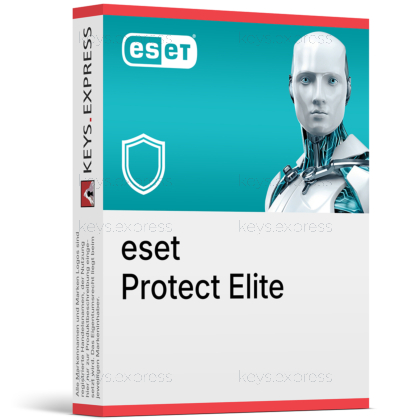
ESET PROTECT Elite is the ESET business tier that combines endpoint, server, mobile, mail and cloud application protection with XDR, vulnerability and patch management, encryption and multi-factor authentication. Every module is administered from the ESET PROTECT console, which runs either as an ESET-hosted cloud instance or as ESET PROTECT On-Prem on your own server.
Single management console – Replaces separate tools for encryption, patching and EDR.
Ransomware rollback – Restores affected files automatically from ESET secured backups.
Full disk encryption – Encrypts Windows and macOS system disks from the console.
Multi-factor authentication – Single-tap mobile approval protects logins against stolen passwords.
Cloud workload protection – Secures Azure, AWS and Google Cloud virtual machines.
Evidence-ready reporting – Over 170 built-in reports covering detections and patch status.
The technical scope fits any size, but the XDR component only pays off if somebody actually looks at the detections. A company without an IT team gets the prevention modules but leaves the most expensive part of the tier unused, unless a service provider operates the console.
| Requirement | Small business | Medium-sized company | Large company |
|---|---|---|---|
| Reporting obligation Switzerland | Rarely | By sector | Often |
| NIS 2 in the European Union | ✕ | By sector | ✓ |
| Security questionnaire from large customers | ✓ | ✓ | ✓ |
| Staff available to review XDR detections | ✕ | Partial | ✓ |
| This product fits | With an MSP | ✓ | ✓ |
The Swiss reporting obligation does not apply to every company: the revised Information Security Act obliges operators of critical infrastructure, including energy and water supply, transport, health, and cantonal and communal administrations, to report a cyberattack to the Federal Office for Cybersecurity (BACS) within 24 hours of discovery, with a further 14 days to complete the report. ESET PROTECT Elite supports that deadline on the detection side, because ESET Inspect records process, file and network activity on the endpoint, so an administrator can establish within hours which device was hit first, what was executed and whether data left the network. Vulnerability and patch management supports the preventive side by listing known CVEs per device and patching third-party applications before they are exploited. What the product does not do is decide whether an incident is reportable, write the report or submit it, and it does not start the 24-hour clock for you, so the classification, the named responsible person and the reporting process remain organisational work. Encryption and multi-factor authentication reduce how many incidents become reportable in the first place, but they do not remove the obligation itself. This description is technical orientation for buyers and does not replace legal advice.
No software product makes an organisation compliant with the NIS 2 Directive, because the directive addresses organisational measures and management accountability rather than tooling. NIS 2 names measure categories including risk analysis and information security policies, incident handling, business continuity and backup management, supply chain security, vulnerability handling and disclosure, cryptography and encryption, access control, and the use of multi-factor authentication. ESET PROTECT Elite maps to several of these directly: incident handling through ESET Inspect, vulnerability handling through vulnerability and patch management, cryptography through full disk encryption on Windows and macOS, and authentication through the included multi-factor authentication module. The console reporting also supports the requirement to assess whether measures are effective, because patch status and detection history can be exported per device instead of merely asserted. The categories it does not cover are business continuity and backup, since ransomware rollback restores files after an attack but is not a backup solution, as well as supply chain security, staff awareness training, and the governance and accountability duties placed on management.
Yes, for the technical half of a typical questionnaire, and the console output is usually accepted as evidence. It answers the questions on centrally managed endpoint protection across Windows, macOS and Linux, on server and mailbox coverage, on whether an EDR or XDR capability is deployed, on encryption of data at rest on company devices, on multi-factor authentication for user and administrator logins, and on documented patch levels for operating systems and third-party software, since these can be exported as reports per device rather than described in prose. It does not answer the questions on backup and tested restores, on a documented business continuity or disaster recovery plan, on security awareness training, on your own ISO 27001 or SOC 2 certification, on penetration testing, on identity governance beyond the authentication step, or on 24/7 monitoring, because no part of this tier includes a staffed security operations centre. Where the gap is monitoring rather than technology, moving to the managed detection and response tier of the same family is normally cheaper and less disruptive than running a second vendor's agent alongside ESET, because the endpoints and the console stay the same. Backup, however, is not part of any module in this tier and has to be bought as a separate product regardless of which ESET tier you choose.
The decisive difference is detection and response: ESET PROTECT Complete stops threats but gives you no forensic view of what happened, while ESET PROTECT Elite adds ESET Inspect, the XDR component that records endpoint activity and lets you reconstruct an incident and respond remotely. The second difference is multi-factor authentication, which is included in Elite and is otherwise a separate purchase. Everything else is identical, so prevention, encryption, mail and cloud application protection, cloud workload protection and patch management are already present in Complete. In practice the question is whether anyone in your organisation, or your service provider, will work with detections rather than only with alerts.
| Capability | ESET PROTECT Complete | ESET PROTECT Elite |
|---|---|---|
| Endpoint, server and mobile protection | ✓ | ✓ |
| Mail and cloud application protection | ✓ | ✓ |
| Full disk encryption | ✓ | ✓ |
| Vulnerability and patch management | ✓ | ✓ |
| Extended detection and response (ESET Inspect) | ✕ | ✓ |
| Multi-factor authentication | ✕ | ✓ |
| Managed 24/7 monitoring | ✕ | ✕ |
The data location of the cloud console is a regional decision made once, at activation: ESET serves the DACH region from its data centre in Frankfurt, so management and detection data is processed inside the European Union rather than in Switzerland, and organisations that must keep this data in-country should deploy ESET PROTECT On-Prem instead, which is covered by the same subscription. Mobile coverage is uneven, because Android devices receive a full security application while iOS and iPadOS devices are only enrolled for mobile device management, so an iPhone fleet gets policy control but no on-device scanning. Mail server protection is built for Exchange, so an on-premises mail server on another platform stays outside the product, although Microsoft 365 and Google Workspace mailboxes are covered by the cloud application module. Patch management has practical edges worth knowing before you plan a rollout: patch rollback is not supported, so patches should be tested on a few machines first, Windows itself is not updated through the patch management menu even though its vulnerabilities are reported, and applications installed inside individual user profiles are not patched. Finally, this tier is technology, not a service, so 24/7 monitoring, threat intelligence feeds, premium support and the AI Advisor module are all separate purchases and are the usual reason for a follow-up order.
It reports operating system vulnerabilities so you can see which machines are exposed, but Windows updates are not applied from the patch management menu. Automatic patching targets third-party applications, and you can check whether a specific CVE is covered directly in the console before you rely on it.
On-premises protection is provided for Microsoft Exchange at server level, with quarantine management and rule-based filtering. Cloud-side protection covers Exchange Online, OneDrive, SharePoint Online and Teams on Microsoft 365, plus Gmail and Google Drive on Google Workspace.
Yes. ESET Inspect provides a public API intended for integration with SIEM, SOAR and ticketing systems, so detections do not have to stay inside the ESET console. This matters if your incident process is already anchored in another tool and you do not want a second place where alerts can be missed.
Yes, cloud workload protection covers Linux and Windows virtual machines running in Microsoft Azure, Amazon Web Services and Google Cloud Platform. They appear in the same console as physical endpoints and servers, so policies and reporting stay consistent across both.